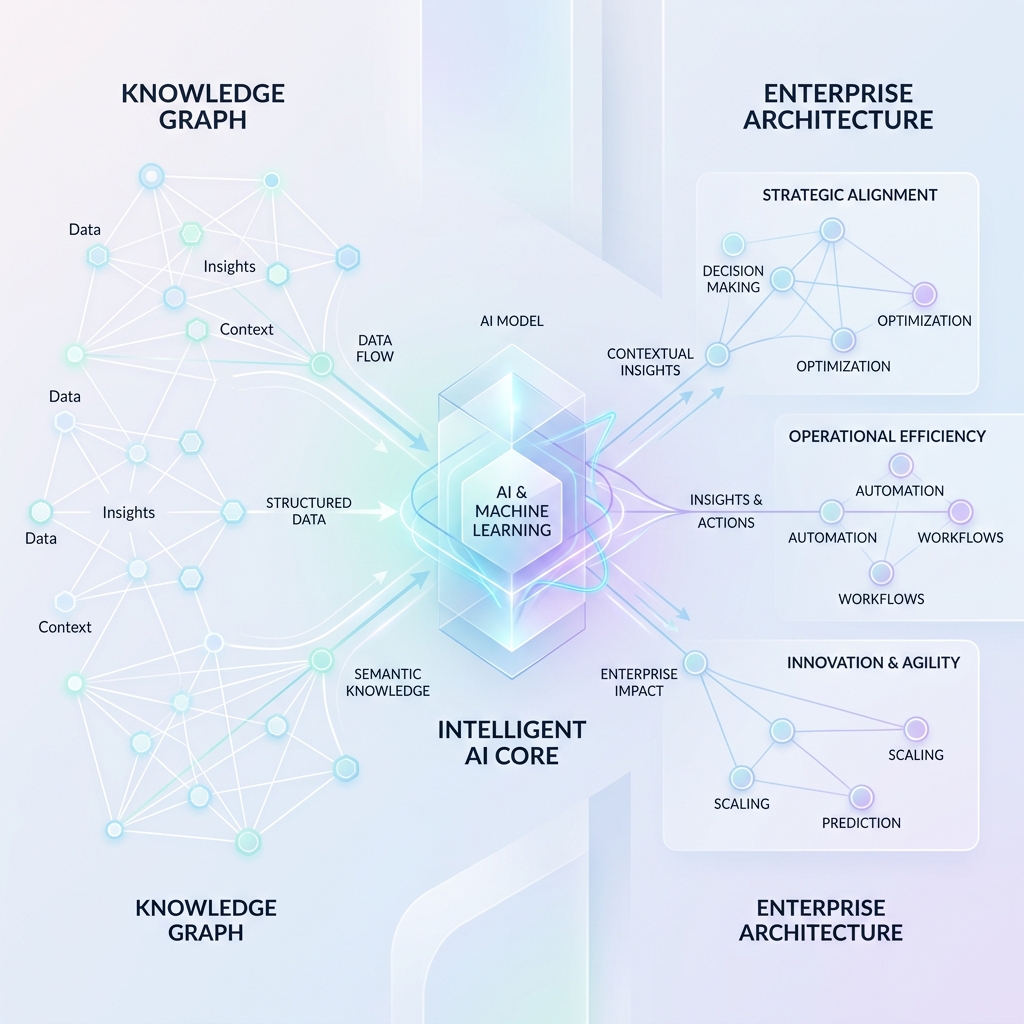
Introduction
I’ve recently been reading “Building Knowledge Graphs” by Jesus Barrasa and Jim Webber, which has sparked some fascinating ideas about the intersection of data relationships and artificial intelligence. One area where this convergence shows immense promise is Enterprise Architecture (EA).
Modern enterprises are vast, complex, and constantly evolving. Understanding the relationship between a critical business capability and the specific servers that support it is often a monumental task. But what if we could simply ask an AI system to analyze and reason over our entire architectural landscape?
By coupling Knowledge Graphs with Large Language Models (LLMs), we can drastically accelerate and enhance Enterprise Architecture.
What is a Knowledge Graph?
At its core, a Knowledge Graph is a way of representing data as a network of interconnected entities and their relationships, enriched with semantic meaning. Instead of storing data in rigid tables, a knowledge graph stores it as nodes (entities like applications, APIs, or business units) and edges (the relationships between them, such as “DEPENDS_ON” or “HOSTS”).
This approach is incredibly powerful for EA because the real world is a graph. Understanding an enterprise is entirely about understanding the connections between its moving parts.
The Foundation: SAP LeanIX
SAP LeanIX is a leading Enterprise Architecture Management tool that helps organizations map out their IT landscape, manage technology portfolios, and plan out enterprise transformations.
If you look closely at how LeanIX operates, it inherently uses a graph-like structure. It maps Business Capabilities to Applications, Applications to IT Components, and Data Objects to Interfaces. It serves as the single source of truth for what exists in the enterprise and how those elements relate to the overarching business strategy.
The Engine: Neo4j
While LeanIX holds this rich, interconnected data, to perform complex, multi-hop reasoning over millions of data points rapidly, we need a system optimized specifically for graph mathematics.
This is where Neo4j comes in. Neo4j is a native graph database designed to store and traverse connected data efficiently. By extracting our graph-like operational data from SAP LeanIX and modeling it as a formal Knowledge Graph in Neo4j, we unlock the ability to run advanced graph algorithms, identify hidden dependencies, and visualize the architecture in real-time.
The Architecture of Reasoning
So, how do we bridge the gap between our structured architectural data and the conversational intelligence of an LLM?
The magic happens when we connect these systems:
- Extract and Load: We pull the structural enterprise data from SAP LeanIX and load it into Neo4j, forming our Knowledge Graph.
- Connect via MCP: We use the Model Context Protocol (MCP) to provide an LLM (such as an AI Copilot) secure, direct access to the Neo4j database.
- Reason and Analyze: Instead of the AI relying on its generic training data, it queries the Neo4j Knowledge Graph directly.
When you ask your Copilot, “What business capabilities will be impacted if we decommission this legacy Oracle database?”, the LLM translates this intent into a graph query. It traverses the Neo4j graph from the database, through IT components, up to the applications, and finally to the business capabilities, presenting a deterministic, fact-grounded answer.
By doing this, we move beyond basic search and start truly reasoning over our architecture—identifying risks, spotting redundancies, and planning transformations with AI assistance.